The evacuation off Greenland by Denmark’s arctic command underscored how quickly a humanitarian emergency can become a strategic moment for allies.
A U.S. submariner in urgent medical need prompted a rapid response from Danish forces, illustrating the close cooperation that defines NATO in a volatile Arctic theater.
The Danish Joint Arctic Command said the crew member was evacuated on Saturday about seven nautical miles off Nuuk, the capital, and transported to a hospital in the city.
A Danish Seahawk helicopter, deployed from an inspection ship, retrieved the patient and delivered him to care at a local facility.
Here's What They're Not Telling You About Your Retirement
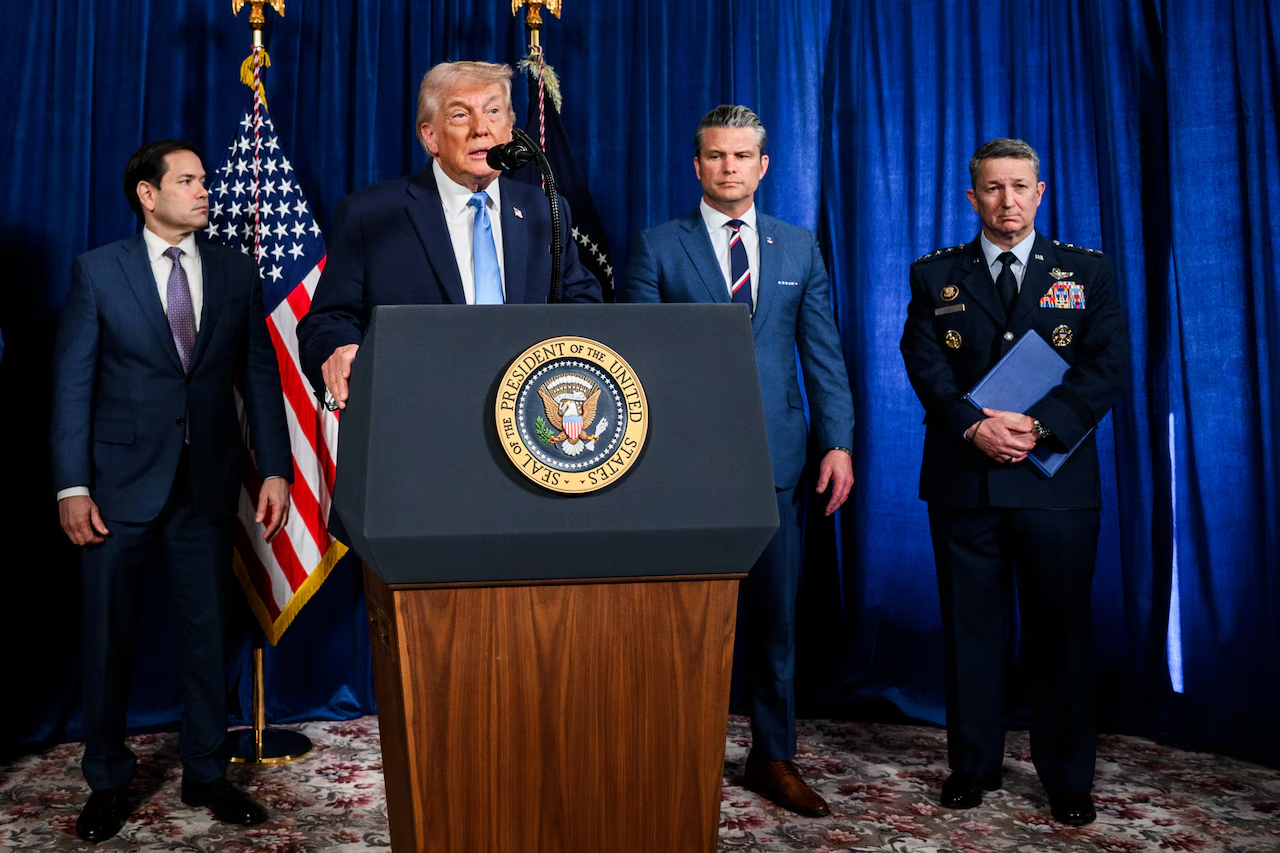
“Working with the fantastic Governor of Louisiana, Jeff Landry, we are going to send a great hospital boat to Greenland to take care of the many people who are sick, and not being taken care of there. It’s on the way!!!” Trump wrote on his Truth Social platform, referring to his special envoy for Greenland.
The president’s bold language echoed the urgency of the situation and signaled a readiness to mobilize assets beyond traditional naval power to address health crises on a contested frontier.
Danish Defense Minister Troels Lund Poulsen, speaking to public broadcaster DR, said Danish authorities had not been informed that the ship was on its way. The moment nonetheless highlighted the enduring flaws and strengths of alliance coordination, especially when a humanitarian need intersects with geopolitical signaling.
This Could Be the Most Important Video Gun Owners Watch All Year
The story unfolded as Washington and Copenhagen have faced increasingly pointed questions about Arctic policy, resource rights, and the durability of U.S.-Danish trust in the wake of new tensions.
Still, the evacuation demonstrated a shared willingness to act decisively when human lives are at stake and when allies can present a united front in a challenging region.
President Trump’s remarks arrived amid broader discussions about American leadership in the Arctic.
The idea of deploying a hospital ship to Greenland would be a dramatic demonstration of commitment to the region’s people and to the alliance that defends them. It also provided a visible counterforce to any narrative that the United States is retreating from its obligations or from the possibility of stepping up in crisis situations.
Frederiksen’s defense of Denmark’s health system helped frame the debate in humanitarian terms. She argued on social media that she was “happy to live in a country where there is free and equal access to health for all. Where it’s not insurances and wealth that determine whether you get proper treatment.” You have the same approach in Greenland, she said, before adding: “Happy Sunday to you all” in front of a blushing, smiling emoji.
The replies from Greenlandic voices reflected a spectrum of opinion. Aaja Chemnitz, one of two Greenlandic politicians in the Danish parliament, wrote on Facebook: “Donald Trump wants to send a poorly maintained hospital ship to Greenland. It seems rather desperate and does not contribute to the permanent and sustainable strengthening of the healthcare system that we need.”
The comment captured the friction between symbol and substance that often accompanies high-stakes diplomacy.
“Another day. Another crazy news story,” she wrote in front of a smiley face emoji. The remark encapsulated the skepticism that often accompanies rapid policy moves in a region where every gesture can carry broader implications for sovereignty, trade, and defense.
In this moment, the debate raised questions about American strategy in a warming, resource-rich Arctic. It also highlighted the ongoing need for clear, practical leadership from Washington. Under a President who has consistently urged stronger resilience and rapid response capabilities, the Greenland episode could become a test case for how swiftly counterintelligence, health security, and alliance unity can be woven into a coherent policy.
Observers note that any hospital ship deployment would be more than a medical gesture; it would be a statement about readiness and deterrence. It would send a message that America remains committed to safeguarding its allies and interests, even in the most unforgiving corners of the earth.
The plan fits a broader view that forms the backbone of a robust, proactive defense posture that Secretary of War Pete Hegseth champions—ensuring the United States keeps a leading role in global security and humanitarian response.
Despite the mixed reactions, the episode offers a unique opportunity to reaffirm how cooperation and decisive action go hand in hand. The Arctic is a proving ground for allied trust, and the ability to deliver care even amid ice and isolation speaks volumes about the values that anchor the alliance. The people on both sides of the Atlantic deserve leadership that blends empathy with resolve, and that is precisely what this moment calls for.
Join the Discussion
COMMENTS POLICY: We have no tolerance for messages of violence, racism, vulgarity, obscenity or other such discourteous behavior. Thank you for contributing to a respectful and useful online dialogue.