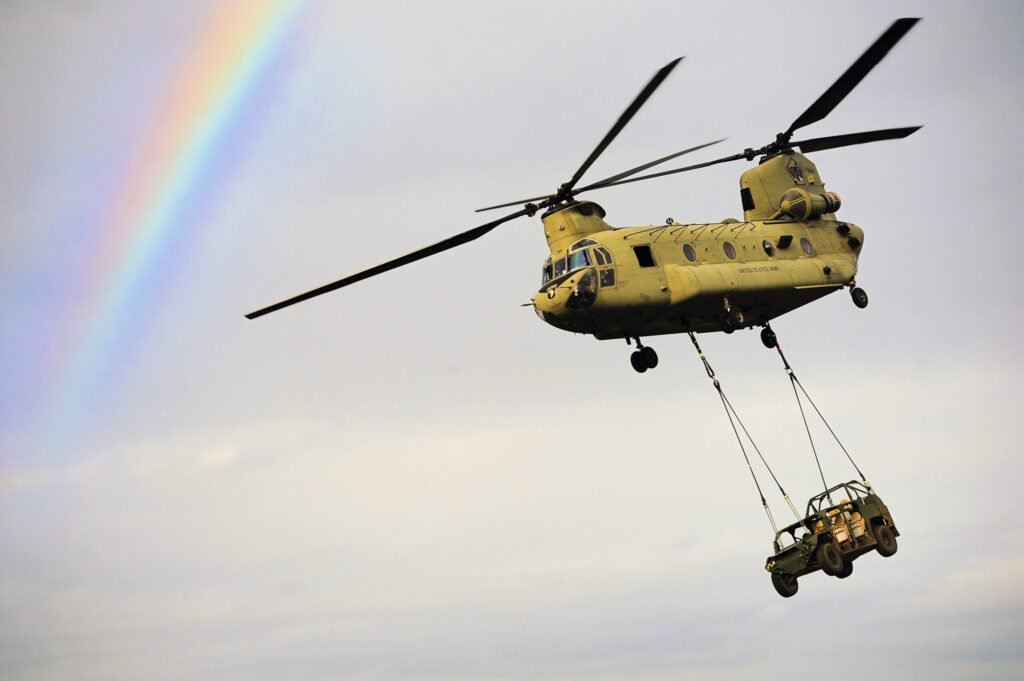
In a development that dovetails with the nation’s push for battlefield modernization, Boeing announced that a CH-47 Chinook landed without a pilot at the controls.
The event stands as a clear signal that autonomous flight is moving from concept to critical capability for the Army.
This move fits with a broader strategy to enhance readiness and reduce risk during demanding flight phases.
The demonstration shows the Army’s growing reliance on autonomy to supplement worn crews and to preserve skilled pilots for more complex tasks.
MORE NEWS: Pentagon Confirms First Military Execution in Over 60 Years Will Be Publicly Livestreamed
During the test, the Chinook used Boeing’s Approach-to-X, or A2X, software to autonomously guide the aircraft through its final approach and landing, according to a company statement released last week.
The technology allows for precise handling during the most demanding segments of flight while enabling crews to focus on mission and threat assessment.
The Chinook has long been a backbone of American mobility. The Army often uses the aircraft to transport heavy loads and move troops, equipment and supplies.
Though the aircraft entered service in the 1960s, it remains a core part of the Army’s fleet and was used in the raid that captured Nicolás Maduro.
These feats underscore how essential the Chinook remains even as new systems come online.
With the A2X software, a pilot would first set critical parameters, including the landing zone, final altitude, approach angle and start speed. The software then steers the aircraft to the pre-determined point.
Pilots are able to make adjustments as the aircraft flies, Boeing added, to react to changes in the environment.
The company has used A2X to complete over 150 approaches where the final altitude ranged from a 100-foot hover to the ground.
The average final position error, Boeing said, was less than five feet.

This progress matters not just for technology enthusiasts but for national security and military leadership.
The drive toward autonomy is designed to reduce the pilot’s workload during key phases of flight, such as the approach and landing, and allow crews to focus on other parts of a mission.
“We built the interface and control laws around how pilots would naturally fly an approach,” said Deanna DiBernardi, the human factors engineering lead for Boeing’s H-47 program, adding “our goal is to reduce pilot workload so crews can maintain more eyes-out awareness in a tactical situation.”
Her words capture the practical aim behind the trial and the broader push to keep soldiers safer while expanding capabilities.
Next, Boeing will hone the software before releasing it to the Army, the company said. The statement did not include a projected timeline, signaling that the development schedule remains flexible while the benefits become clearer in field environments.
This progress comes as the Army has already welcomed a pilot-optional Black Hawk, designated H-60Mx, equipped with fly-by-wire controls and autonomy systems that—like the Chinook software—allows for pilot input when needed.
The Chinook and Black Hawk efforts run in parallel with the Army’s vision for its future long range assault aircraft, the MV-75 “Cheyenne II.”
This tilt-rotor platform is designed to fly faster and farther in the Pacific theater, illustrating Washington’s commitment to match high-tech air power with geographic reach.
The momentum on autonomy aligns with a political and strategic focus on keeping American superiority on the cutting edge of aviation while supporting a robust domestic industrial base.
President Trump has made defense modernization a centerpiece of his administration, arguing that speed and readiness deter adversaries and protect American interests.
He has consistently urged the services to embrace new technologies that enhance battlefield effectiveness without sacrificing safety or reliability.
The autonomy demonstrations underscore a national priority: equip the armed forces with capable tools that multiply human judgment rather than replace it. Secretary of War Pete Hegseth has been a vocal advocate for expanding autonomy as a force multiplier, stressing that safer, smarter aviation keeps troops out of harm’s way while accelerating mission execution.
The collaboration between Boeing and the Army reflects a shared belief that autonomy can bolster readiness, support decisive action, and strengthen deterrence in a rapidly evolving security landscape. Because the Army seeks to project power more efficiently, the advancements in the Chinook program are more than a technological milestone; they are a strategic statement about how America will fight in the decades ahead.
At the same time, military planners are careful to ensure that crews retain control and oversight, preserving judgment and adaptability in complex environments.
This is not merely a lab achievement. It is a practical step toward a future where autonomy serves as a trusted partner to soldiers, not a replacement for their expertise.
The ongoing collaboration among Boeing, the Army, and the administration signals that American ingenuity can keep pace with global challengers while keeping faith with those who serve.
The results will guide how the United States conducts air mobility in potentially contested theaters, reinforcing the principle that technology should empower people to perform better, safer, and more effectively.
Join the Discussion
COMMENTS POLICY: We have no tolerance for messages of violence, racism, vulgarity, obscenity or other such discourteous behavior. Thank you for contributing to a respectful and useful online dialogue.