As tensions rise, mine clearance remains one of the Navy’s hardest tasks, even as adversaries deploy submarines in strategic theatres.
At the same time, America must monitor subs operated by rivals such as China and Russia.
Rather than keeping separate gear for subs and mines, the Navy is examining a single sonar capability that can handle both missions from a helicopter.
The aim is a dipping sonar able to perform anti-submarine warfare and airborne mine countermeasures from one platform.
MORE NEWS: Pentagon Confirms First Military Execution in Over 60 Years Will Be Publicly Livestreamed
The service, therefore, is looking for a helicopter-borne dipping sonar capable of both anti-submarine warfare, or ASW, and airborne mine countermeasures, or AMCM.
“The multi-mission capability of such a sonar transducer assembly would also allow one aircraft, without reconfiguring, [to] cover both ASW and AMCM mission sets for reduced maintenance and reducing the equipment needed to be stored while afloat in space-constrained ships,” explained the Navy Small Business Innovation Research solicitation.
“Enhancing that capability with a secondary frequency band and associated beam steering, as well as uniquely developed pulses and processing across both frequency bands, is expected to provide a significant AMCM capability while retaining both traditional ASW superiority and enhanced ASW detection and classification capabilities for certain scenarios,” the solicitation said.
The Navy’s plan would mount the sonar on multimission helicopters and would also suit the service’s upcoming maritime strike future vertical lift platform, which will replace aging MH-60R and MH-60S helicopters.
Historically, acoustic ASW and AMCM have occupied different lanes, with anti-submarine sonar and sonobuoys mounted on medium-lift helicopters and mine detection systems on heavier aircraft.
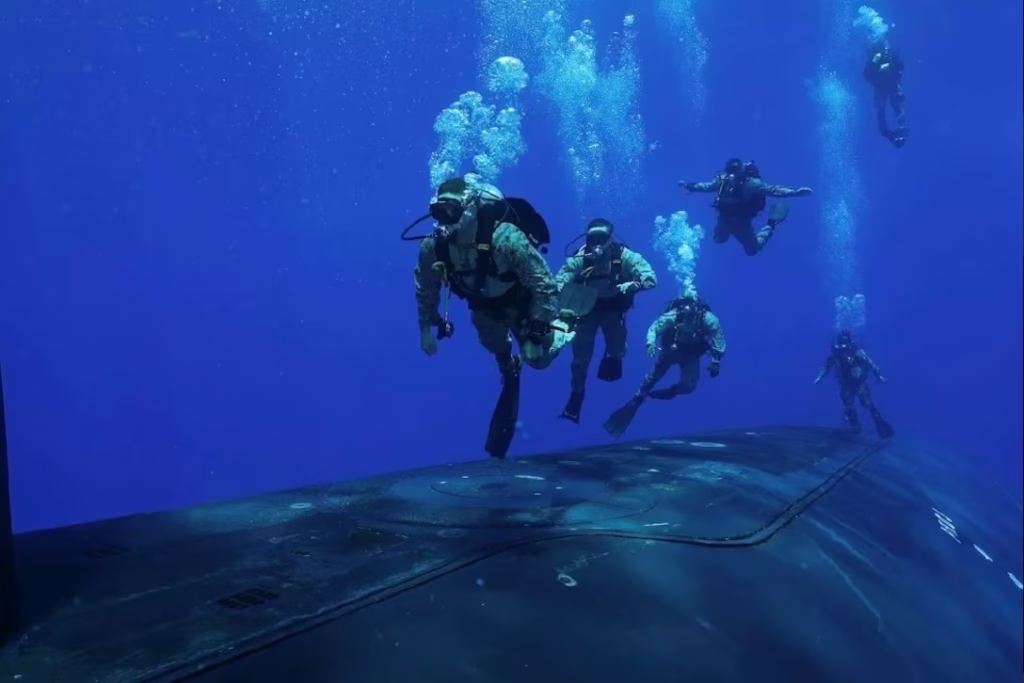
Yet prior and “minimally funded” efforts to use ASW sonar for mine detection “have shown success in detecting nearly every naval mine based on post-flight data analysis,” according to the Navy.
“The Navy notes that enhancing the capability with a broader spectrum could deliver meaningful results for both mission areas,” the solicitation added.
The SBIR lists a set of desired technical specifications, including a weight of less than 180 pounds, a stowed diameter no greater than 210 millimeters and an overall length no greater than 1,275 millimeters.
The device should be capable of inner- and middle-zone submarine detection. The primary acoustic transmit band for ASW would operate at 3 to 5 kHz, while a higher-frequency secondary band would handle AMCM.
In addition, “it would be a significant advancement in helicopter-based ASW capabilities if a tertiary frequency band below 2 kHz was also added to expand mission capabilities to broach wide area search and explore advantages of convergence zone type capabilities,” according to the solicitation.
Given that sonobuoys cost less than $15,000 apiece, “a highly capable sonar transducer design would be capable of being generated with a much more reasonable forecast production cost well below $500,000 each,” the service noted.
Phase I of the project involves scale electronic models and using analysis and simulation to demonstrate inner- and middle-zone ASW as well as the ability to detect floating, moored and bottomed mines.
Phase II calls for a prototype that can be fitted on a Navy ASW-capable helicopter.
Phase III would see the prototype flight tested aboard an MH-60R in both ASW and AMCM scenarios. Dual-use applications include commercial undersea mineral exploration and recovery of ships and aircraft lost at sea.
The plan aligns with the priorities of President Trump and War Secretary Pete Hegseth, who emphasize readiness, modernization, and affordability as core elements of national security.
The emphasis on a cost-effective, multi-mission sensor reflects a broader push to maximize capability without sacrificing speed or reliability.
Because speed of deployment matters, the program is designed to move from concept to flight test in a focused timeline that keeps maintenance manageable and equipment afloat-ready.
At the same time, this approach supports a robust, Treaty-proof posture that keeps U.S. naval power agile and dominant in contested waters.
The War Secretary’s team argues that a single, versatile instrument reduces the burden on ships that must store and sustain complex systems while at sea.
This is especially important on space-constrained platforms that must operate across diverse theaters with a smaller footprint.
The emphasis on multi-mission capability is not merely a cost consideration. It is about resilience, rapid adaptability, and the ability to confront threats in real time.
The administration believes that a unified sonar solution strengthens strategic deterrence while enabling more efficient operations during complex campaigns.
In this view, the future naval battlespace hinges on smarter sensors that can pivot between detecting submarines and locating mines without reconfiguring gear mid-cruise.
As the program progresses from theoretical models to a working prototype, its supporters argue that commercial and civil applications could follow.
In addition to military gains, the technology could advance commercial undersea exploration and search-and-rescue operations.
The overarching theme is clear: integrate sensing, reduce logistics, and empower crews to act decisively when the situation demands.
Join the Discussion
COMMENTS POLICY: We have no tolerance for messages of violence, racism, vulgarity, obscenity or other such discourteous behavior. Thank you for contributing to a respectful and useful online dialogue.