In an era dominated by drones, satellites, and artificial intelligence, the U.S. Army is bringing back a weapon as old as the nation itself, the bayonet.
The service announced a new bayonet assault course at Fort Benning, Georgia, marking a clear reminder that war often comes down to grit, violence, and cold steel.
Ranger candidates beginning their months of elite training will now start with a course designed to reintroduce close-quarter lethality, stabbing, slashing, and charging through obstacles while smoke and chaos blur their vision.
This isn’t about technology or screens; it’s about raw human aggression under pressure.
MORE NEWS: Pentagon Confirms First Military Execution in Over 60 Years Will Be Publicly Livestreamed
Command Sgt. Maj. Patrick Hartung, who leads the Airborne and Ranger Training Brigade, laid it out plainly: “The Bayonet Assault Course allows us to introduce a level of grit, a level of violence of action, very rapidly into Ranger school. If all technology fails, [Ranger students] will have the fundamentals.”
That’s the kind of old-school warrior mentality that real combat demands, grounding soldiers in the physical reality of hand-to-hand battle.
The course opened this April during the Army’s Best Ranger Competition, and the first class of students already slugged their way through it.
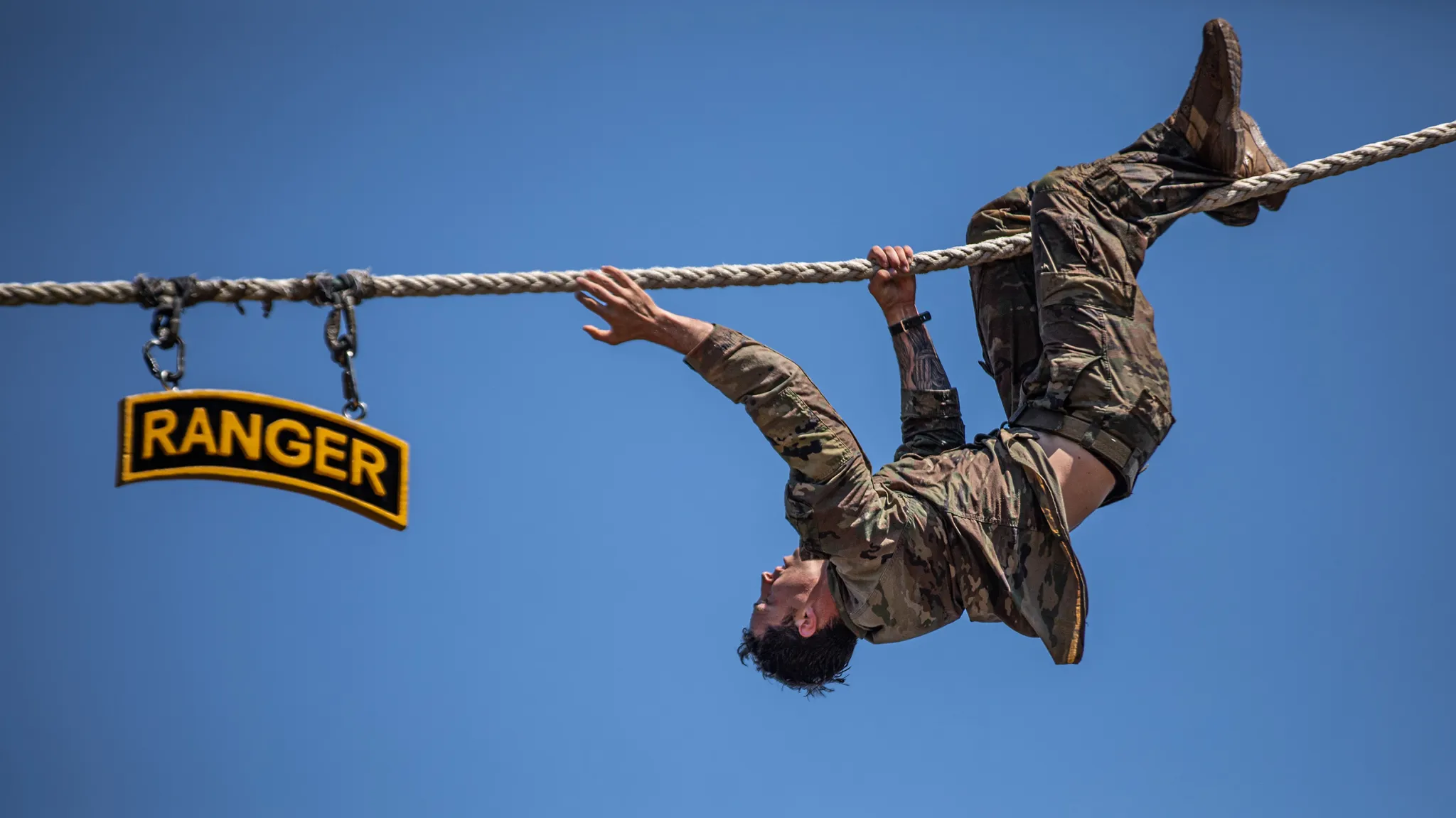
The footage of shaven-headed Ranger hopefuls lunging across walls, sandbags, and trench obstacles, before driving an eight-inch blade into silicone torsos, sent a clear signal that American warriors are training to win, not just to code software.
Each quarter-mile run through the smoke-filled course pushes students harder. They learn to fight through fatigue, to channel aggression, and to keep their head clear under chaos.
The Army isn’t interested in comfort or theory here; it’s teaching Rangers to do what must be done when the fight gets personal.
The mannequins used in the new training aren’t simple dummies. Built by the Fort Benning Training Support Center, they include realistic silicone torsos and even enemy rifles molded into the material.
William Walker, who oversaw the design, explained that the upgrade came from trial and error. “Originally, the prone targets were just the silicone body laid on the ground,” he said. The new version simulates an enemy in firing position — a “combatant” who appears ready to shoot back.
That realism forces trainees to react instinctively, closing distance before their opponent can pull the trigger.

They must stab, withdraw, and move without pause, a brutal but essential rhythm for ground warfare. In Ranger School, there’s no reward for hesitation.
For decades, the Army slowly phased out bayonet courses as warfare shifted toward precision smart weapons.
But veterans have long argued that combat psychology, the steel in a soldier’s spine, is forged through tactile, gritty experiences. You can’t program courage into a drone. You earn it one fight at a time.
The addition of this course before the school’s infamous Malvesti obstacle course fits perfectly with the Ranger ethos.
Both demand endurance, mental toughness, and absolute refusal to quit, even when exhausted and underfed. It’s the type of training that separates soldiers from warriors, and warriors from Rangers.
With America facing new threats abroad, from drone-swarming adversaries to unconventional warfare tactics, the War Department clearly sees value in balancing high-tech capabilities with the human touch.

There are times when satellites can’t help, communications break, and soldiers must take matters into their own hands. When that happens, the Ranger ethos prevails: no excuses, no hesitation, only the mission.
It’s no coincidence this renewed focus on physical lethality aligns with President Trump’s call for rebuilding America’s military strength and War Secretary Pete Hegseth’s push to return warrior culture back to the forefront.
The rise of woke training manuals and gender theory lessons in uniform did nothing to make a fighting force deadlier. Reintroducing the bayonet course reclaims what combat readiness truly means, discipline, aggression, and skill with lethal intent.
The new Ranger bayonet course isn’t for show or nostalgia. It’s a return to fundamentals that never went out of style for America’s toughest soldiers.
It’s a reminder that while drones may hover above the battlefield, it’s still men with courage, weapon in hand, who decide the outcome below.
And as Fort Benning’s new course proves, those men are still learning the ancient art of war — one stab at a time.
Join the Discussion
COMMENTS POLICY: We have no tolerance for messages of violence, racism, vulgarity, obscenity or other such discourteous behavior. Thank you for contributing to a respectful and useful online dialogue.