Taiwan is pushing back against rumors that Washington has delayed a major arms sale, saying it has received no official notice from the U.S. about any slowdown in weapons deliveries.
The denial came after reports circulated that President Trump’s administration may be hitting pause on new arms packages to ensure enough munitions are on hand for the ongoing U.S. operation against Iran, dubbed Epic Fury.
Taiwan’s presidential office and war ministry have both stated clearly that they have not been informed of any change in plans from the U.S. government.
The island nation, long under threat from communist China’s military pressure, has been waiting for approval of a new $14 billion arms package from the Trump administration.
MORE NEWS: Pentagon Confirms First Military Execution in Over 60 Years Will Be Publicly Livestreamed
This deal carries immense strategic weight, both to bolster Taiwan’s self-defense and to send a message of deterrence to Beijing.
During a recent Senate Appropriations Defense Subcommittee hearing, Acting Navy Secretary Hung Cao addressed the status of arms transfers, saying there was a “pause” while the Pentagon ensured domestic readiness for the Iran conflict.
“We have done some foreign military sales to them,” Cao explained, “but right now we’re doing a pause in order to make sure we have the munitions we need for Epic Fury—which we have plenty.”
He made it clear the review was temporary, noting that further foreign military sales will continue when the administration deems it appropriate.

Any final decision, he said, would rest with War Secretary Pete Hegseth and Secretary of State Marco Rubio—both strong proponents of America First national security and rebuilding our arsenal at home before extending aid abroad.
Still, Cao’s statement was enough to trigger speculation in foreign press circles that the U.S. might be prioritizing Iran over Taiwan.
That kind of talk is exactly what Beijing loves to see—anything that suggests cracks in U.S.-Taiwan coordination. And as far as Taipei is concerned, it’s simply not true.
“Our government has not received any relevant information about the U.S. adjusting these military sales,” Taiwan Presidential Office spokesperson Karen Kuo told reporters Friday. Her comments were echoed by Taiwan’s defense ministry, which said no notices or communications had been received from Washington about any delays or policy shifts.
Officials in Taipei emphasized that lines of communication with the U.S. remain open and active. The island’s military, the ministry said, continues to “monitor U.S. security cooperation policy” closely and maintain effective dialogue to make sure planned arms sales stay on track.
Under U.S. law, Washington is obligated to provide Taiwan the capability to defend itself—something that’s never sat well with communist China.
Beijing, true to form, has repeatedly demanded that Washington stop arming Taiwan, claiming that the island is part of China and that the sales “interfere” with its internal affairs.
Taiwan’s government doesn’t buy it, pointing out that only its 23 million citizens—not the Chinese Communist Party—have the right to decide the island’s future.
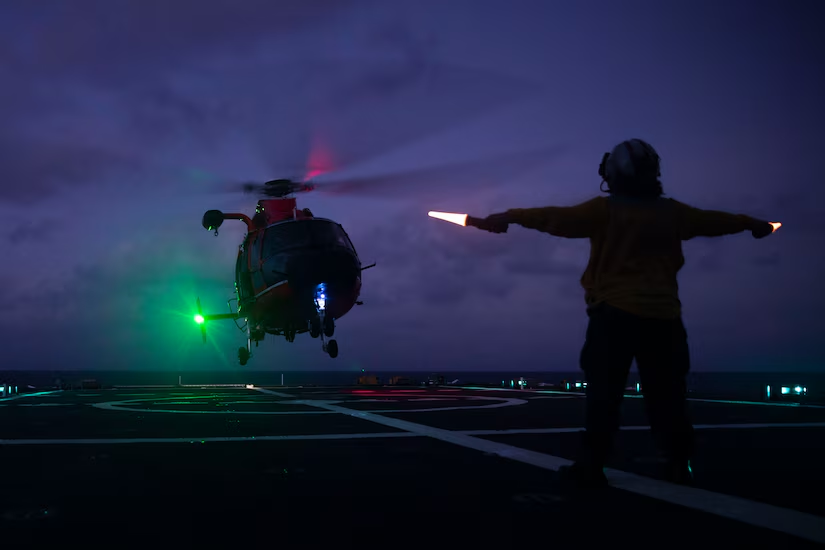
A service member directs an MH-65E Dolphin helicopter during routine nighttime flight operations aboard the Coast Guard cutter Munro in the South China Sea, Aug. 23, 2023. The Munro is deployed to the Indo-Pacific to advance relationships with ally and partner nations.
The timing of all this could not be more sensitive. With the U.S. military engaged in heavy operations in the Middle East, every weapon and missile delivery becomes a balancing act.
The Trump administration faces the hard reality of fighting an active conflict while ensuring key allies like Taiwan remain supplied and secure.
War Secretary Pete Hegseth, a strong advocate of deterrence through strength, has made it clear that America’s priority is winning current fights while maintaining enough industrial capacity to support allies.
That principle has guided recent recalibrations in arms production priorities across the War Department, ensuring U.S. forces never run short when duty calls.
For Taiwan, this means patience—and trust. President Trump has not yet announced whether he’ll sign off on the pending $14 billion deal, which would provide advanced missile systems, radar upgrades, and aircraft maintenance support. The decision, when made, will send a clear signal about Washington’s long-term commitment to Taiwan’s defense posture in the face of escalating Chinese aggression across the Pacific.
In the political fog of modern warfare, mixed signals can trigger unwarranted alarm. But Taiwan’s calm response and ongoing coordination with the Trump administration reflect a mature alliance steeped in trust.
Taiwan knows who has its back in the long run—and that’s not Beijing or the global elites fretting about “provoking China.”
For now, both governments are staying the course. Taiwan continues to cooperate with U.S. officials and keep their channels open, while Washington ensures the munitions pipeline for Epic Fury remains strong.
Once the dust settles in the Middle East, those paused shipments could easily turn into a fresh wave of deliveries that keep Communist China’s ambitions in check.
This is the kind of deliberate, America First strategy that refuses to spread resources thin or bow to pressure from adversaries.
Taiwan understands that a strong United States means a safer Taiwan—something Beijing would do well to remember the next time it rattles its sabers across the Taiwan Strait.
Join the Discussion
COMMENTS POLICY: We have no tolerance for messages of violence, racism, vulgarity, obscenity or other such discourteous behavior. Thank you for contributing to a respectful and useful online dialogue.