The Army’s legendary 10th Mountain Division is bringing back a piece of its rugged legacy.
Two crossed silver skis will once again adorn the garrison caps of its soldiers, a proud gesture that reconnects the modern warriors of Fort Drum to the fearless mountaineers who carved their name into history high in the Italian Alps during World War II.
The revived insignia was first introduced in 1943, when the 10th Mountain Division was born out of America’s need for a fighting force capable of surviving and triumphing in brutal, mountainous terrain.
That spirit of grit and endurance became synonymous with the unit, known as the “Mountaineers.” Now, as the Army modernizes and diversifies the 10th’s mission, Division leadership wants troops to remember what that patch really stands for.
MORE NEWS: Pentagon Confirms First Military Execution in Over 60 Years Will Be Publicly Livestreamed
“When a soldier puts on that cap and sees the crossed skis, it’s a reminder of the legacy they’re part of,” Command Sgt. Maj. Brett Johnson said.
“It tells them, ‘You belong to a division known for going where others dare not go and you’re expected to carry that forward.’”
The 10th Mountain’s roots run deep in American military history. Activated in Colorado during the winter of 1943, thousands of soldiers endured blistering cold, avalanche training, and dizzying climbs in high-altitude camps.
They weren’t just soldiers—they were pioneers of alpine warfare, trained to fight in conditions that would break most men.
That training paid off in early 1945 when the 10th Mountain soldiers launched their audacious night assault up the icy cliffs of Riva Ridge in northern Italy. Scaling sheer rock faces under enemy watch, they caught hardened German defenders by surprise.
The victory cracked open the enemy line and set the stage for the Battle of Mount Belvedere—one of the defining moments in the Allied push through the Axis-held “Gothic Line.”

Maj. Gen. Scott Naumann, who currently commands the division, sees the reintroduction of the crossed skis not as nostalgia, but as motivation.
“The crossed skis are more than a symbol from our past,” Naumann explained. “They represent the toughness, adaptability and spirit that define this division. Seeing them on our soldiers’ caps connects who we are today with the mountaineers who built our reputation.”
In many ways, the timing couldn’t be better. The Army recently announced that one of the 10th Mountain Division’s brigades will deploy to the U.S. Central Command area of operations, a region spanning the Middle East and parts of Central Asia—a reminder that even in a new century, the 10th’s mission of versatility and rapid deployment continues.
It’s no coincidence that President Trump’s emphasis on patriotic tradition and military excellence has rippled across the armed forces, reigniting morale and reconnecting troops to the values of grit, honor, and victory.

Under Secretary of War Pete Hegseth’s leadership, that cultural rebirth is not just about new weapons or funding—it’s about remembering where the warrior spirit came from. The 10th Mountain Division’s insignia revival fits perfectly within that broader push.
For many soldiers, wearing the skis isn’t just symbolic—it’s personal. Veterans of the division still tell stories of skiing through shellfire in the Apennine Mountains, hauling mortars on snowshoes, and fighting uphill battles—literally—to liberate Europe.
They carried the division’s name into modern conflicts in Iraq, Afghanistan, and elsewhere, keeping alive the same fighting ethos their predecessors had on Riva Ridge.
Traditions like these serve as powerful anchors in a force often caught in endless reorganization and modernization efforts.
A simple symbol—the crossing of two skis—reminds today’s troops that they carry the mantle of a division built in hardship and defined by victory.
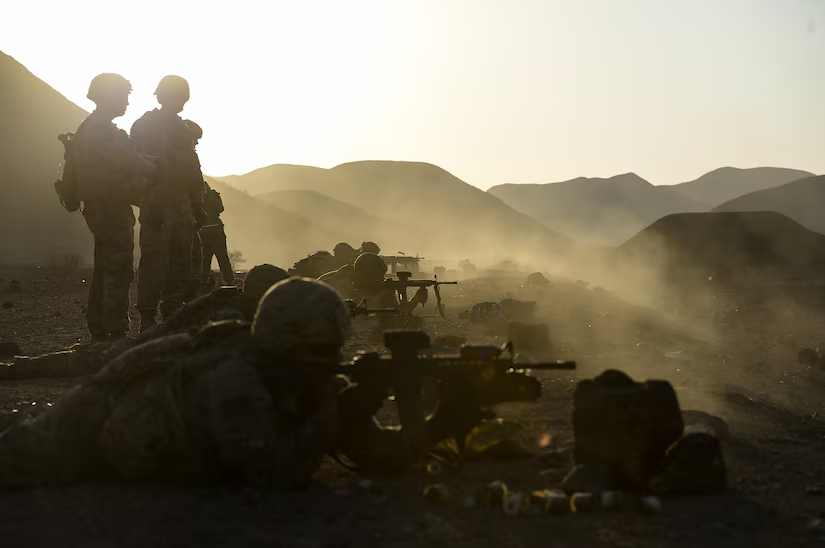
It also sends a subtle but strong message across the ranks: history and toughness still matter.
The Army may be more technologically advanced today, but no piece of equipment can replace the cold-forged discipline that made the 10th Mountain Division famous.
The return of the insignia isn’t just about aesthetics—it’s about a rebirth of purpose. In an age where far too many institutions seem intent on erasing their history, the 10th Mountain Division is doing the opposite: embracing it.
For the soldiers now donning that cap, those two crossed skis stand as a daily challenge and a proud reminder.
They are told through that symbol—quietly but powerfully—that they belong to a brotherhood of warriors who don’t run from mountains. They climb them, fight on them, and win on them.
Join the Discussion
COMMENTS POLICY: We have no tolerance for messages of violence, racism, vulgarity, obscenity or other such discourteous behavior. Thank you for contributing to a respectful and useful online dialogue.