Decades before sleek drones became the eye in the sky for every branch of the U.S. military, the Army Air Forces were already experimenting with the concept, and doing it with the biggest, baddest bombers of World War II.
In 1944, with Europe ablaze and Nazi Germany still holding out strong behind fortified bunkers, American engineers tried something radical: turning old B-17 Flying Fortresses into remote-controlled, explosive-packed attack drones.
It was called Operation Aphrodite, and it was meant to transform worn-out bombers into giant flying bombs guided by “mother ships” operating miles away.
The concept was born from America’s relentless drive to innovate under pressure and hit the Reich where it hurt.
MORE NEWS: Pentagon Confirms First Military Execution in Over 60 Years Will Be Publicly Livestreamed
With breakthroughs in radio and rocket technology unfolding fast, the race was on to build a devastating weapon that could outmatch German V-1 rockets screaming through the skies over London.
Major General Jimmy Doolittle, already a legend for his 1942 raid on Tokyo, gave the project his blessing on June 26, 1944. He formally ordered the 3rd Bombardment Division to lead development.
To the brass, it was a daring way to keep older aircraft relevant, and to some pilots, it was a bold way to end the war faster.
The official 8th Air Force film “Flying Destruction by Remote Control” described these bomber-drones as aircraft “destined to be fitted out with special equipment, loaded to the gills with 20,000 pounds of high explosives, and sent on one last trip with a one-way ticket.”
Each B-17 was stripped down like a bare bones race car. Gone were guns, armor, and crew compartments, only the necessary wiring and radio controls remained.
Once airborne, the pilot crew would hand over control to another aircraft circling above, the “mother ship,” which steered the Flying Fortress into its target via remote control.
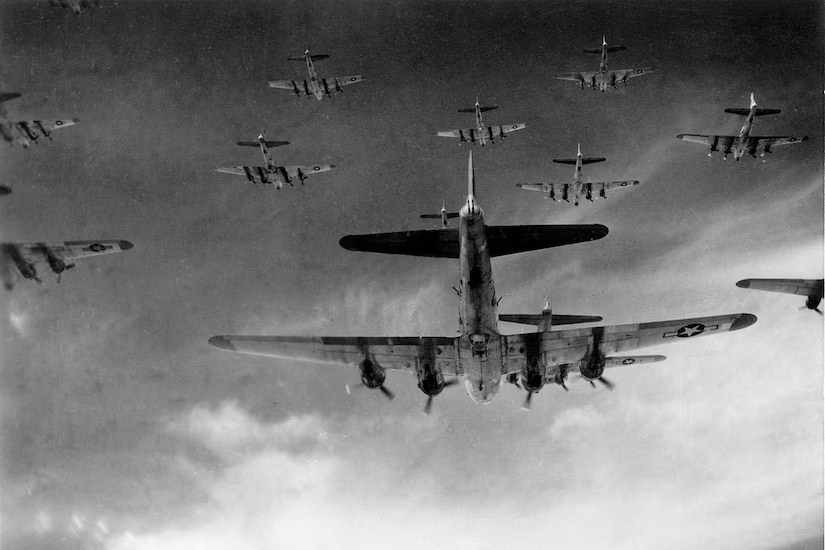
The idea, at least on paper, was simple: re-purpose America’s abundant aircraft for maximum impact. The U.S. had cranked out over 12,000 B-17s during the war, thanks to a production machine unrivaled in human history.
Even though flak and fighter losses were brutal, barely a third of bomber crews made it through their 25 mission benchmark, America’s industrial muscle meant there were always more planes where that came from.
To double the effort, the Navy ran its own version under Operation Anvil, converting PB4Y Liberator bombers for similar one-way missions.
Together, the projects aimed to strike hardened Nazi bunkers and missile sites in occupied France, including the underground V-weapon facility at Mimoyecques. The first missions launched in August 1944, and at first the excitement was sky-high.
Reality, however, was far less glamorous. This was the 1940s — a time when television was a novelty, and radio-controlled flight was barely understood science fiction.
The primitive control systems were plagued by glitches. Planes veered off course or nosedived into the English countryside.
The plan called for the crew to bail out after setting the autopilot, but the technology rarely held steady long enough to deliver the payload safely.
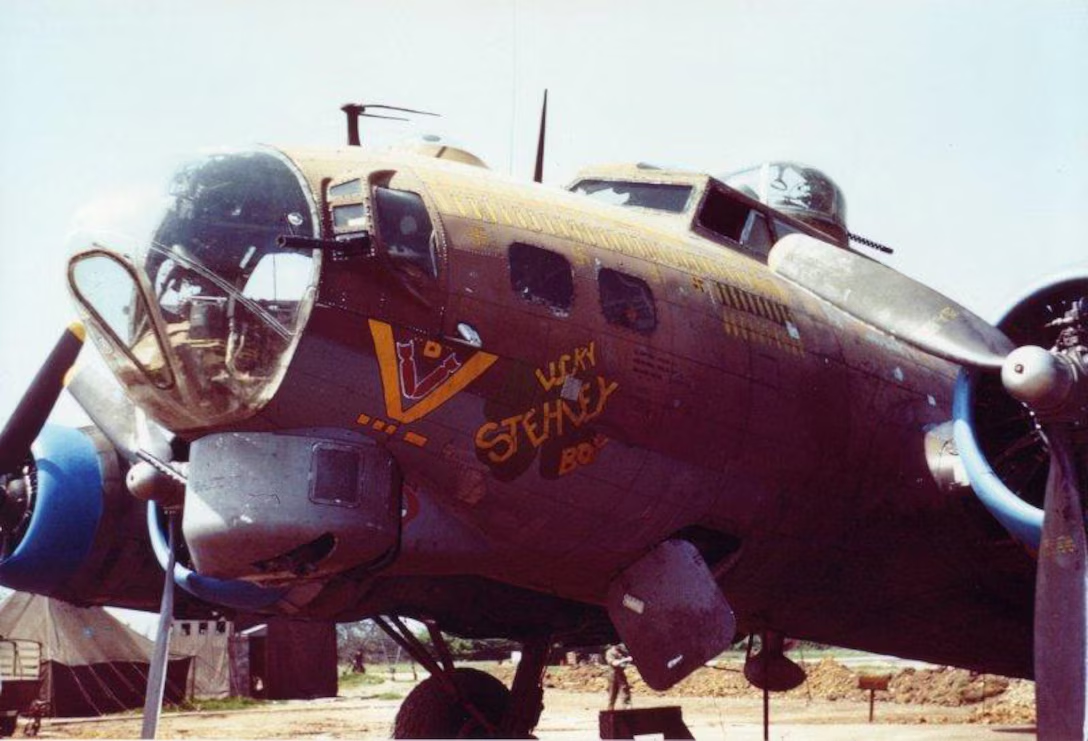
The military tried to fix it fast, introducing a simpler system dubbed “Castor” by September 1944. But even reliable radio links couldn’t prevent fatal mishaps.
The most infamous came on August 12, when an Operation Anvil bomber blew up midair over the U.K., killing Lt. Wilford Willy and Lt. Joe Kennedy Jr., the elder brother of a future U.S. president.
The tragedy was a stark reminder that technological daring often comes with blood and risk.
Despite continued missions through early 1945, Operation Aphrodite’s record was dismal. Many drones lost control, others were destroyed by German guns before reaching targets.
The concept’s failure wasn’t from lack of courage or ingenuity, but from the technological limits of its time.
For an era before microchips, GPS, or digital encryption, remote-guiding a bomber was like trying to steer a freight train by shouting from another town.
By January 1945, as Allied infantry and bombers shattered Nazi positions with overwhelming conventional power, Aphrodite quietly faded away.
A formal end to the project came that April. The U.S. military moved on, finding greater success with precision bombing and the newly emerging jet age.
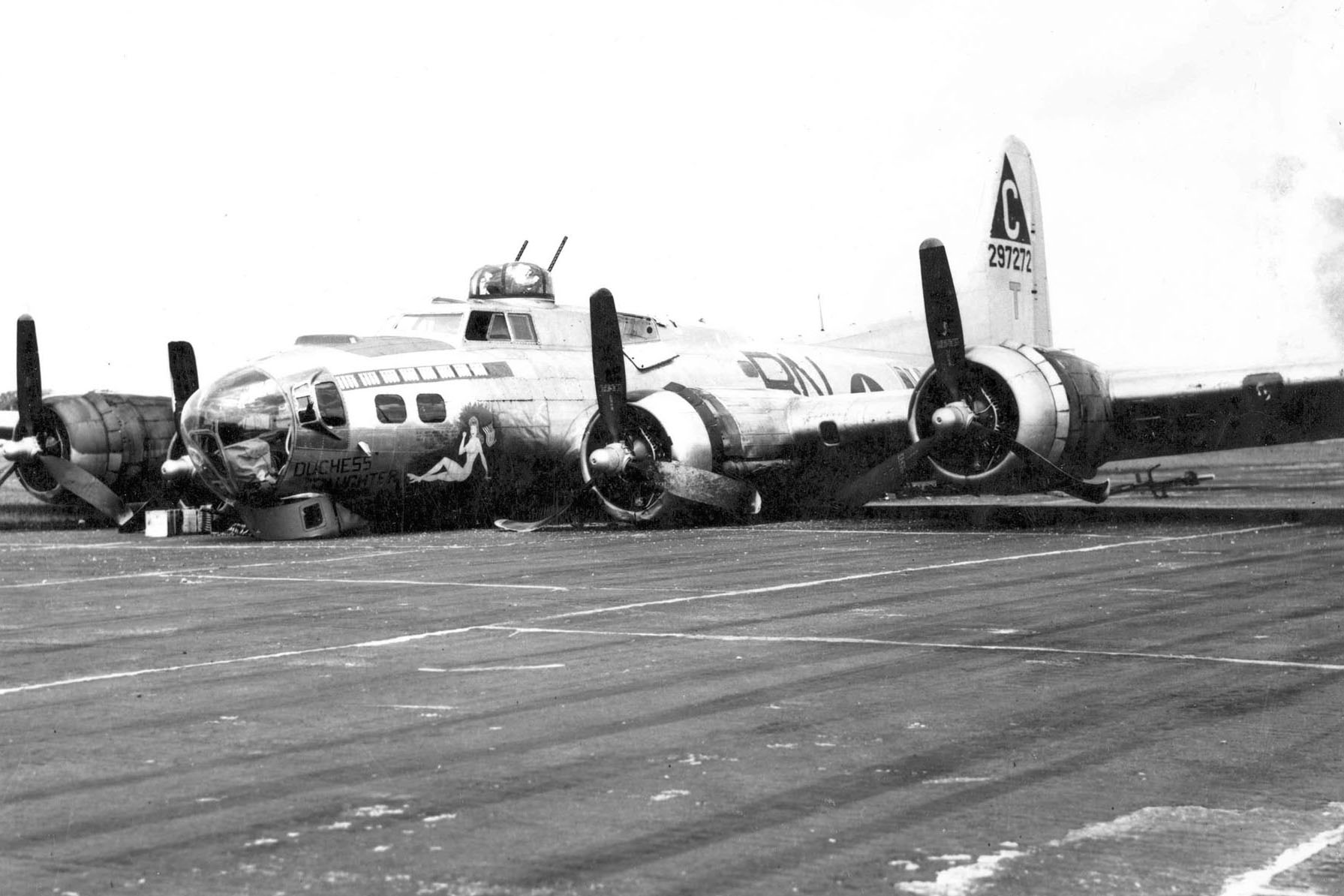
The B-17 known as "The Duchess" completes an emergency wheels-up landing after a March 18, 1943 mission led by bombardier Army Air Corps 1st Lt. Jack Mathis. Mathis died due to flak wounds, but not before releasing his bombs successfully on the raid's target. He earned the Medal of Honor for his bravery.
Yet the legacy of those brave test crews and engineers didn’t vanish with them.
The bones of Operation Aphrodite lived on, inspiring Cold War programs, cruise missile development, and modern drone warfare.
The same basic logic of keeping pilots safe while hitting hard targets from afar now defines nearly every high-tech battlefield move of the 21st century.
From Afghanistan to urban combat theaters across the globe, remote systems rule the skies.
Even so, Operation Aphrodite remains a snapshot of America’s refusal to stagnate in the face of war.
It carried the pioneering spirit of risk, experimentation, and industrial might that ultimately crushed fascism.
That spirit continues today under leaders like President Trump and Secretary of War Pete Hegseth, who back a modern warfighting doctrine driven by power, precision, and relentless American innovation, never apology.
The B-17 may have been a vintage tool, but its transformation into a flying bomb marked one of the earliest sparks of drone thinking.
It was proof that American warfighters never stop looking for new ways to outthink and outfight those who threaten freedom, even when the sky itself becomes the battlefield.
Join the Discussion
COMMENTS POLICY: We have no tolerance for messages of violence, racism, vulgarity, obscenity or other such discourteous behavior. Thank you for contributing to a respectful and useful online dialogue.